Compare
Mailyte vs Postmark: mailboxes and campaigns alongside your app email
Mailyte brings your team’s mailboxes and your campaigns into the same account as your app email, on one naira invoice. Postmark is built around transactional email, with message streams that keep promotional mail apart, official libraries in many languages, inbound processing and a public status page. Mailyte has no SDKs and publishes no delivery statistics.

The difference
What sets Mailyte apart
Mailboxes and campaigns in the same account
Your team’s mailboxes, your app’s email and your campaigns in one dashboard, on one invoice.
Marketing on its own path
Campaigns leave on a different path from transactional mail, so a newsletter is kept off the path that carries your password resets.
Billed in naira
Pay by card or bank transfer in naira, or in dollars if you prefer.
Side by side
Mailyte and Postmark, row by row
This compares scope, visibility and billing — not delivery speed.
| Mailyte | Postmark | |
|---|---|---|
| What you sign up for | ||
| Business mailboxes on your own domain | Yes. Free for up to 5, then from ₦850 a mailbox a month, billed yearly. | Not offered. Its products are an Email API, an SMTP service and message streams. |
| Email from your app (SMTP and REST API) | Yes, over SMTP and REST. 500 a day free; plans from ₦4,550 a month for 25,000. | Yes: an Email API and an SMTP service. |
| Email marketing campaigns | Yes. Free up to 500 contacts; plans from ₦2,900 a month. | Promotional mail can be sent through a separate broadcast stream. |
| Sending and visibility | ||
| Transactional and bulk mail kept apart | Yes. Campaigns leave on a different path from transactional mail. | Yes: its docs describe message streams as parallel, completely separate sending infrastructures. |
| Batch send in one call | Yes, up to 500 recipients a call. | Yes, up to 500 messages per API call. |
| Delivery logs you can read | 3, 30 or 90 days of visible history by plan | 45 days on Basic. On Pro and Platform, 45 by default and up to 365 days with an add-on. |
| Signed webhooks | 17 event types, each signed with HMAC-SHA256 | No HMAC signing: its docs say Postmark “does not currently support HMAC webhook signature verification” and recommend Basic Auth and IP allowlisting. |
| Published status and delivery statistics | A public status page that probes each listed service live. No published history. | A public status page with incident history, where its pricing page says it shares its delivery statistics for the major inbox providers. |
| Where Mailyte stops | ||
| Official SDKs and libraries | — | Official libraries for Node.js, Python, Ruby, PHP, Java, .NET and TypeScript, among others. |
| Inbound processing with parsed JSON | — | Yes on Pro and Platform: inbound mail becomes a JSON object posted to your webhook URL. |
| Price and billing | ||
| Prices quoted in | Naira and dollars. | US dollars. |
| Payment methods | Card or bank transfer. | Visa, MasterCard, American Express, Diners and JCB; not PayPal or purchase orders. |
| Free plan | Yes, on each product, with no time limit. | Yes: 100 emails a month, with no overages allowed. |
Postmark’s details are from its own public pages, checked on 12 October 2026: Postmark pricing, Postmark home, Postmark libraries, Postmark webhooks, Postmark batch emails, Postmark status. Prices and plans change, so check Postmark’s own pages before you decide.
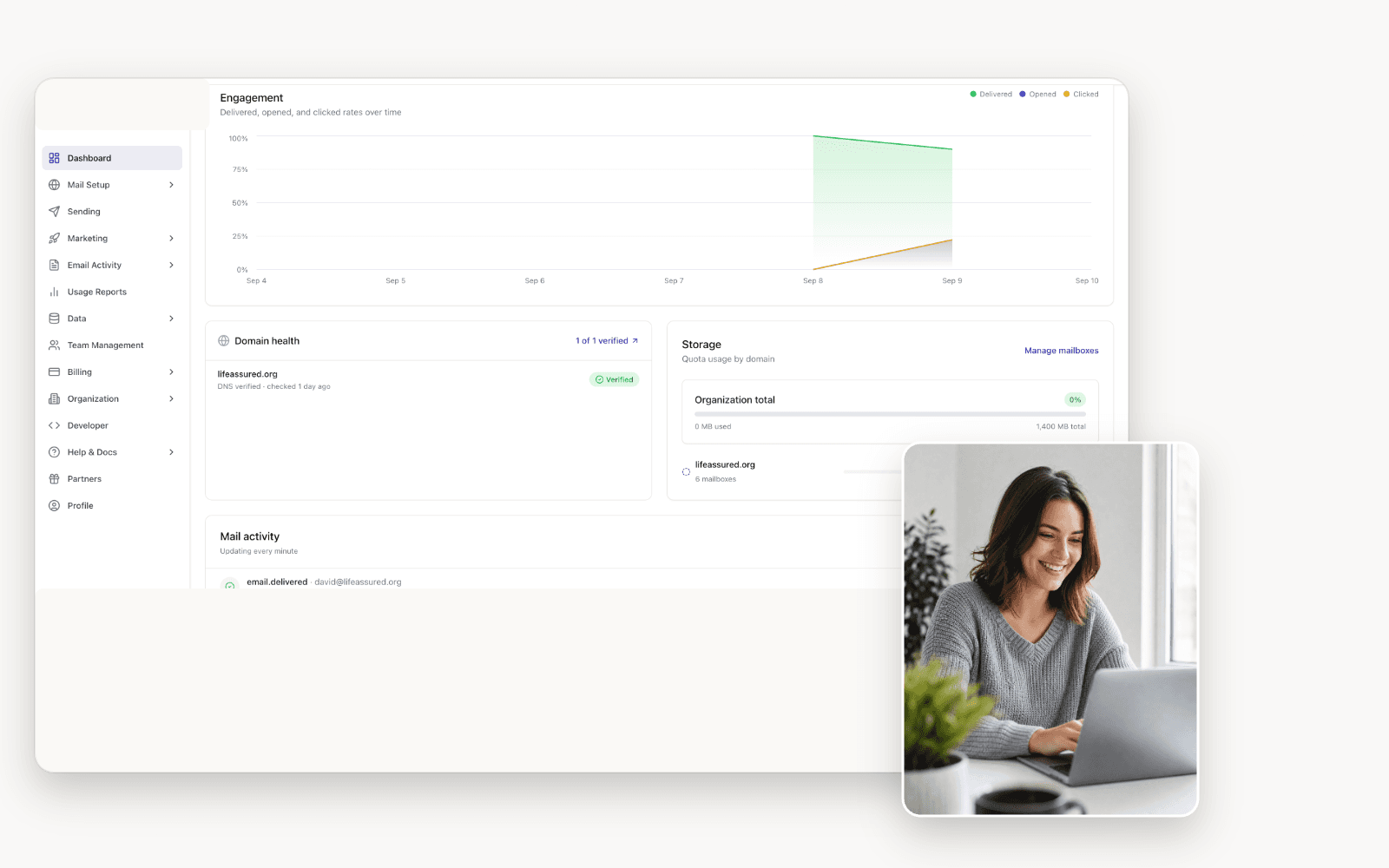
Status
A status page that checks live
Mailyte’s public status page probes each service it lists, live: a connection to the mail ports and a request to the web surfaces. It keeps no uptime history, so it shows no percentage. If it cannot reach a service, it says so.
- Mail ports checked with a live connection
- Web surfaces checked with a live request
- No uptime percentage without a measurement behind it
Choose Postmark if
- You want published delivery statistics. Postmark’s pricing page says it shares its delivery statistics for the major inbox providers on its status page, which also keeps an incident history. Mailyte’s status page probes each listed service live but publishes no history, and there is no SLA below Enterprise.
- You want an official SDK in your language. Postmark lists official libraries for Node.js, Python, Ruby, PHP, Java, .NET and TypeScript, among others.
- You need inbound processing. On its Pro and Platform plans Postmark turns arriving mail into a JSON object posted to your webhook; Mailyte has no parse pipeline.
- You send transactional email only, and you want a vendor that does nothing else.
Choose Mailyte if
- You need mailboxes and campaigns as well as transactional sending.
- You want to pay in naira, by card or bank transfer.
- You want new contacts checked before you email them.
- You want the option to run the mail server yourself: its core is open source under the AGPL-3.0.
Compare Mailyte with Mailgun, SendGrid, Mailchimp, MailerLite or Brevo. You can also see business email, app email and email marketing in one platform or go straight to pricing.
Frequently asked
Does Mailyte do email marketing as well as transactional email?
Yes. Mailyte sends app email over SMTP or a REST API and runs email marketing campaigns and journeys from the same account, alongside hosted mailboxes for your team.
Can I switch from Postmark to Mailyte without changing my code?
Over SMTP, mostly: point your SMTP client at Mailyte’s relay with new credentials. Over the API, the endpoints and payloads differ — message streams map to Mailyte’s stream field or to campaigns — so that path is a mapping exercise rather than a one-line change. Mailyte publishes an endpoint-by-endpoint map from Postmark.
Does Mailyte publish delivery statistics like Postmark’s status page?
No. Mailyte has a public status page that probes each listed service live, but it publishes no uptime or delivery-time history, and there is no service level agreement below the Enterprise plan. Postmark’s pricing page says it shares its delivery statistics for the major inbox providers on its status page; if published statistics matter to you, that is a reason to choose Postmark.
Does Mailyte have SDKs like Postmark’s?
No. Mailyte is one REST API with one key and scopes, plus a drop-in SMTP relay, so any HTTP client is the integration. There are no client libraries. Postmark lists official libraries for Node.js, Python, Ruby, PHP, Java, .NET and TypeScript, among others.
Does Mailyte keep transactional and marketing mail apart, like message streams?
Yes, on different sending paths. Campaigns leave Mailyte on a different path from transactional mail, so a newsletter is kept off the path that carries your password resets.
Does Mailyte sign its webhooks?
Yes. Every webhook request carries an HMAC-SHA256 signature of the raw body in the X-Mailyte-Signature header, which you verify with your webhook’s signing secret. Postmark’s documentation says it does not currently support HMAC webhook signature verification, and recommends Basic Auth and IP allowlisting instead.
How long can I see delivery logs for?
Delivery logs are on for every plan, including the free one: 3, 30 or 90 days of visible history by plan.




Try Mailyte free.
Free mailboxes to start, with free plans for app email and marketing. No card needed.